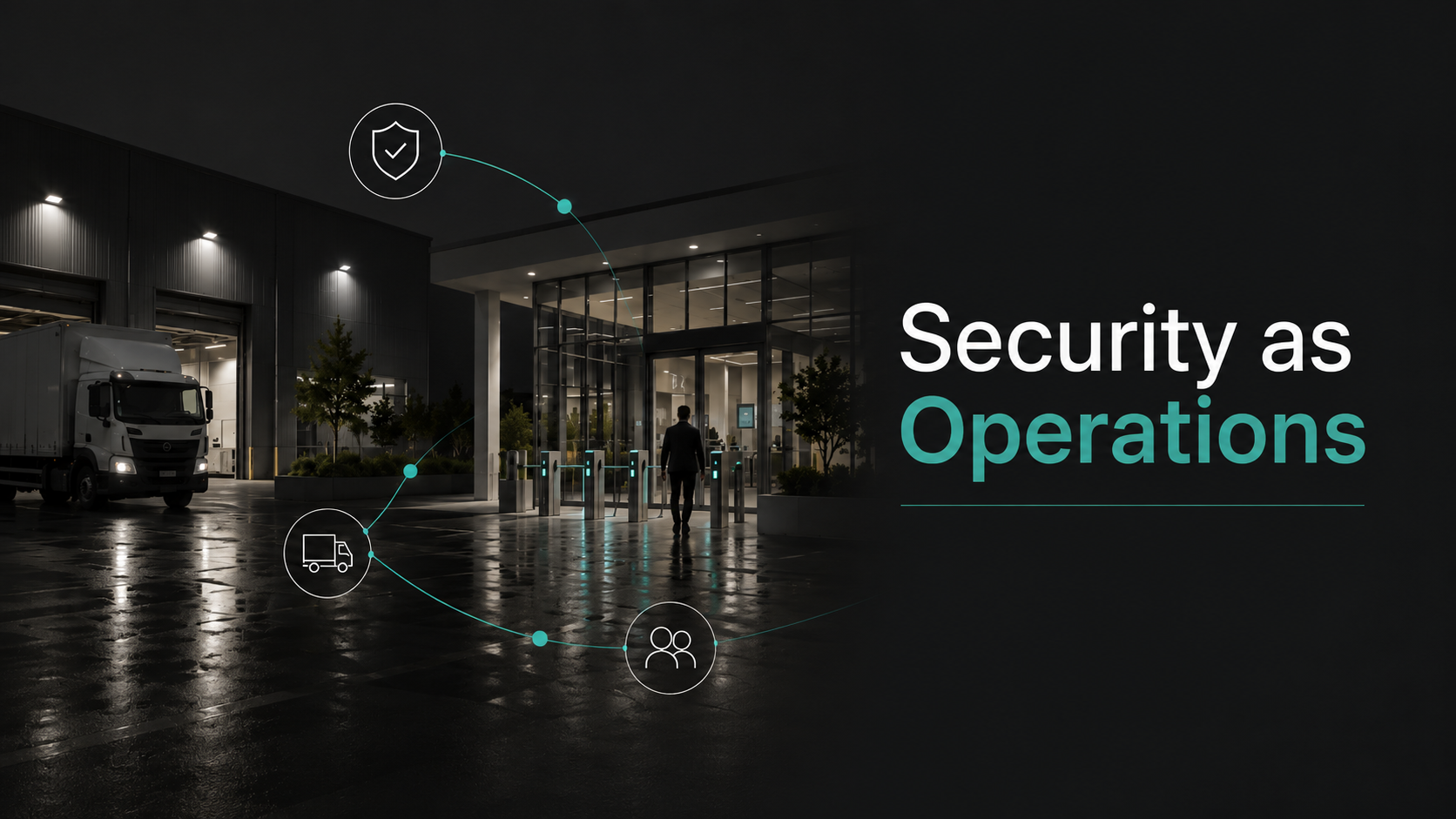
The Vital Disconnect Between Security and Operations. Most Organisations Are Still Treating It Separately
When operations start bending under pressure, you don’t hear an alarm straight away. You see small adjustments. A rerouted delivery. A last-minute contractor swap. Someone granting access because waiting would slow everything down. It feels practical. Sensible, even.
Then it accumulates.
And somewhere in that accumulation, security stops behaving like a contained function and starts acting like a byproduct of everything else going on. It seeps into decisions people don’t label as “security” at all.
That shift is already visible in the data, if you look in the right places.
Across global supply chains, the signal is getting louder.
Cargo theft rose 56% year-on-year in 2025, according to BSI Group reporting. The incidents themselves vary, some blunt, some surprisingly organised, others almost opportunistic, but the common thread sits underneath. These events are rarely isolated anymore. They connect. A delay here, a staffing gap there, a routing change somewhere else, and suddenly the exposure isn’t one incident, it’s a chain reaction playing out across operations.
At the same time, analysis points to something slightly uncomfortable. Many organisations detect risk signals late, even when they technically have the data. Early warnings exist. They just sit in different systems, owned by different teams, interpreted in isolation.
So the information is there. It just doesn’t arrive as a single, usable picture.
This is where things start to go awry.
Because security, in practice, now lives inside operational movement. Everyone has to weigh in.
Supplier changes. Staff rotations. Access decisions made on the fly. Timings that slip by half an hour and force adjustments downstream. You can watch it unfold in real environments. Warehouses, hotels, logistics hubs, anywhere with moving parts. It’s constant.
And the structure most organisations use hasn’t caught up with that reality.
Security still sits in its own lane on paper.
Separate function. Separate reporting. Separate tools.
It looks organised. It satisfies governance expectations. It produces documentation that reads well.
But the environment it’s supposed to represent behaves differently.
Because operational decisions carry security consequences now, whether anyone labels them that way or not.
Think about it for a second.
A supplier changes. That affects who arrives on-site.
That changes access requirements.
That shifts movement through a building.
That alters oversight, even slightly.
Each step feels operational. Together, they shape exposure.
It’s all connected. You can feel that instinctively, even if it’s hard to map cleanly.
There’s another layer here, and it’s worth sitting on for a moment.
Organisations are investing more in tools. Dashboards, monitoring systems, alerts, data feeds. On paper, capability is improving. In reality, clarity often isn’t.
Why?
Because tools are not being added into a cohesive structure.
So you get more signals, more data points, more noise. And still, when something shifts, people pause. They look around. They try to piece together what’s actually happening. That lag, even a small one, matters.
Risk now behaves like a moving system.
It builds through:
supplier dependencies
Staffing variability
Timing pressure
Site-level adjustments
Small decisions that feel temporary
Individually, none of it stands out. Collectively, it shapes outcomes.
And by the time it shows up cleanly in a report, it’s already unfolded.
That changes what organisations need.
Not more documents scattered across systems. Not another layer of policy sitting slightly detached from reality.
Visibility. Proper visibility.
A shared, grounded understanding of how the organisation is functioning in real conditions. Where pressure is building. Where dependencies overlap. Where those small adjustments are starting to stack in ways that could tip into something bigger.
It sounds simple when written down. In practice, it’s hard.
Because most systems capture pieces.
They store data. They support reporting cycles. They help with audits. All useful. All necessary.
They don’t reflect the organisation as a living system. That’s the gap.
And the gap is widening.
Operational environments are getting faster, more interconnected, less predictable. The structure underneath needs to match that pace. Otherwise, decisions rely on partial views, stitched together under pressure, which is rarely where you want to be.
Comapnies need a way to bring sites, suppliers, operational activity, and security exposure into one structure that reflects how things actually run. Real. Connected. Moving.